21 May 2026
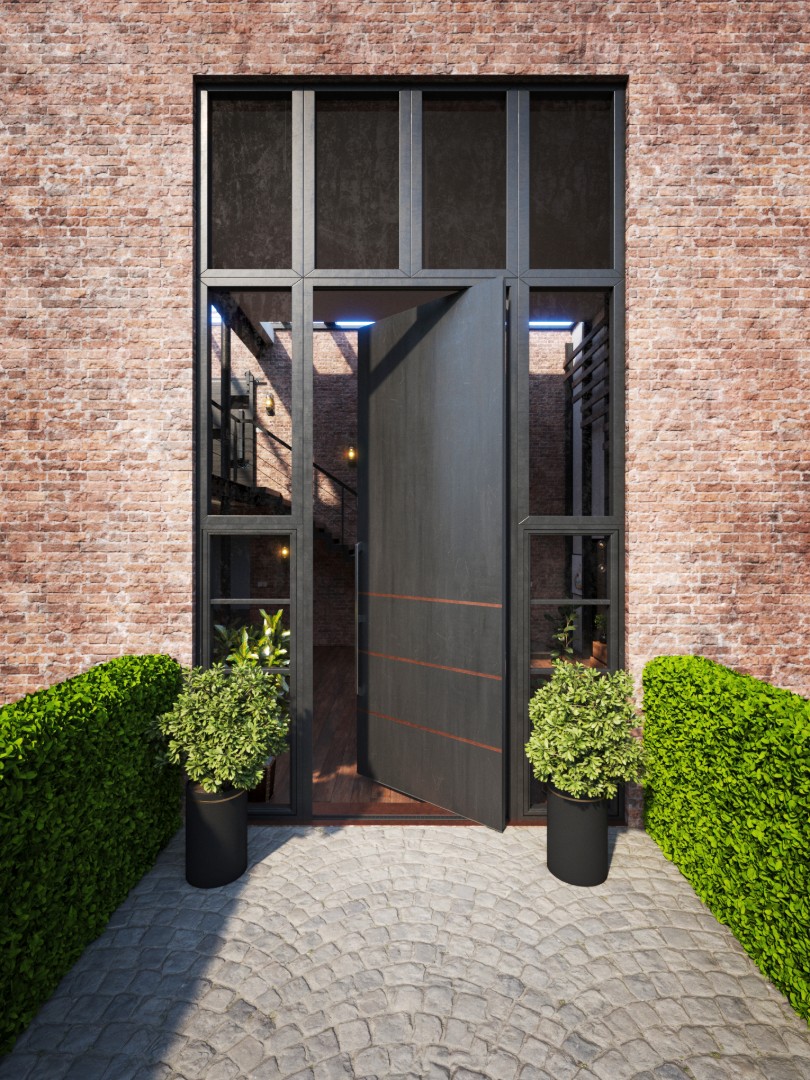
Choosing a slim-frame aluminium entrance door is not just choosing a door: it shapes the whole facade. This is where a standard product and an architectural solution part ways. The narrower the visible profile, the more the construction, glazing, sealing and manufacturing precision matter.
A narrow frame looks light, clean and premium. At the same time, expectations for stability, thermal insulation, airtightness, security and everyday usability rise. For owners, architects and contractors, the question is not only how it looks but how maturely the minimalist design has been engineered.
What is behind a slim aluminium entrance door?
The narrow frame is not a mere detail. It decides how much glass is visible, how fine the facade lines are and how precisely the door fits a modern design. In clean, minimalist buildings, profiles that are too wide quickly spoil the proportions.
Aluminium has clear advantages for entrance doors: it is dimensionally stable, long-lasting and well suited to demanding outdoor use. It allows very slim constructions without giving up stiffness, which makes it ideal for minimalist entrance doors with large glass areas.
A narrow frame is not a goal in itself, though. A profile reduced too far costs technical performance. Good systems find the balance: minimal sightlines without compromising tightness, resistance to warping or hardware integration.
Why a narrow frame is architecturally stronger
An entrance door is never isolated. It relates to windows, fixed glazing, facade axes and the interior. Narrow frames make glass areas look larger and transitions calmer, and the building as a whole looks more precise.
In premium homes and modern projects this creates the desired understated look: the focus stays on surfaces, not on massive profiles, especially when the door is combined with side lights, transoms or large glass panels.
Slim aluminium frames are also timeless. Decorative leaves or dominant profile shapes date quickly, while a minimalist entrance door stays harmonious for years, which makes it attractive for owners and planners who think long term.
Technical requirements
The cleaner the look, the higher the demands on the system behind it. Outdoors, an entrance door must do much more than look good, and several technical layers must work together.
The thermal break is essential. A modern aluminium entrance door needs a profile system with low heat transfer while keeping the slender look. Poorly designed slim profiles quickly become weak points, so good systems are developed as systems from the outset, not slimmed down afterwards.
The seal level is just as important. Driving rain, air permeability and wind load place serious demands on frame geometry and manufacturing accuracy, and narrow profiles do not tolerate imprecision. If tolerances are not controlled, it shows in daily use.
Statics matter too. Large glass areas, heavy safety glass and tall leaves create significant loads. Narrow frames only convince when profile section, corner joints, hardware and threshold work as a matched system.
Security without a heavy look
Many assume a slim entrance door is less secure. Not necessarily. Aluminium is an excellent basis for integrating burglar resistance, multi-point locking and safety glazing into an elegant, slender design.
What matters is treating security as part of the system, not an add-on: stable profile chambers, strong hinge fixings, compatible hardware and the right glass build-up. The transitions between frame, leaf and glass should show no visual or technical breaks. The good answer lies in intelligent construction, not in more mass.
Sound insulation: often underestimated
With entrance doors, attention usually goes first to design and thermal insulation. In practice, sound insulation is at least as important, especially in cities, next to busy roads or in dense neighbourhoods.
A slim aluminium entrance door can perform very well here when profile, seals and glazing are matched, also for glazed doors and doors with side lights. Planners should address this early; if sound insulation comes up late, compromises in profile choice, glass thickness or connections often follow.
Custom made instead of compromises
A premium entrance door can rarely be defined well with standard sizes. In demanding architecture, custom manufacturing decides whether proportions, lines and function truly come together, and with narrow frames the smallest deviation shows.
Custom widths, heights, side lights, transoms, opening directions and handle concepts need a system that is modular yet precise and consistent. For fabricators and installers it also matters how easily and repeatably the system can be built. When construction, hardware integration, production logic and accessories form one system, the result is a premium product and an efficient process.
Material, finish and sustainability
Outdoors, aluminium also offers clear advantages in finish, colour range and durability. Powder-coated or anodised versions fit modern facade concepts precisely and keep their premium look for many years.
Sustainability now weighs more heavily in many decisions: recycled aluminium, long-lasting constructions and repairability are part of the investment. A door that works aesthetically and technically for decades is a better ecological choice than a short-lived one.
Stay realistic, though: not every finish suits every environment, and not every extremely minimal design suits every installation. Coastal locations, busy entrances or very exposed facades may call for different priorities.
Who benefits most?
The greatest value appears where architecture wants to look clean and consistent: modern family homes, villas, premium apartment buildings and representative commercial entrances. Narrow frames bring precision, more light and a calm facade.
For window makers and partners, such systems are interesting when the market asks for distinctive premium solutions. Customers buy not just a door but a visible promise of quality, which the product must keep in every detail.
XS-ALU focuses on exactly this point, with its own aluminium systems such as Radikal, which turn extremely narrow sightlines, high sound insulation and precise production logic into a reliable system product.
What to check when choosing
Do not decide by the thinnest profile alone, but by the balance of aesthetics, technical performance and buildability: reliable data on thermal insulation, tightness, security, sound insulation and hardware, plus manufacturing quality, finish and how precisely the system connects to wall, threshold and facade.
The details decide. Is a low threshold possible? How is the glass fixed? Which locks and smart-home solutions can be integrated? Does it stay slender at large sizes? These questions show whether a door was simply well marketed or truly engineered. Planned well, a slim aluminium entrance door delivers a clean facade and an element that provides calm, security and durability every day.