19 May 2026
Whoever wants to shape floor plans rather than just use them sooner or later arrives at glazed interior folding doors. They open spaces generously, divide them clearly when needed and look lighter than many classic doors. That is their appeal, and their planning challenge: a good solution is defined not only by the opening type but by profile widths, running gear, glazing, sound insulation and how it fits the architecture.
When is a glazed folding door the better choice?
Not every opening needs a hinged or sliding door. In interiors whose use changes, a folding door works especially well. It opens wide passages without needing a permanent wall area for a sliding leaf, in open living concepts as well as meeting rooms, studios, hotels or refined offices.
The real added value appears where transparency and flexibility are both expected. Glass keeps visual connections, brings daylight deep into the plan and makes the division feel light, especially in urban projects where few square metres must do a lot, or in architecture built on clear axes and restrained materials.
A folding door is not universal, though. If maximum sound insulation, complete airtightness or a very low budget come first, weigh carefully. The higher the expectations, the more system quality and precise detailing matter.
The profiles define the effect
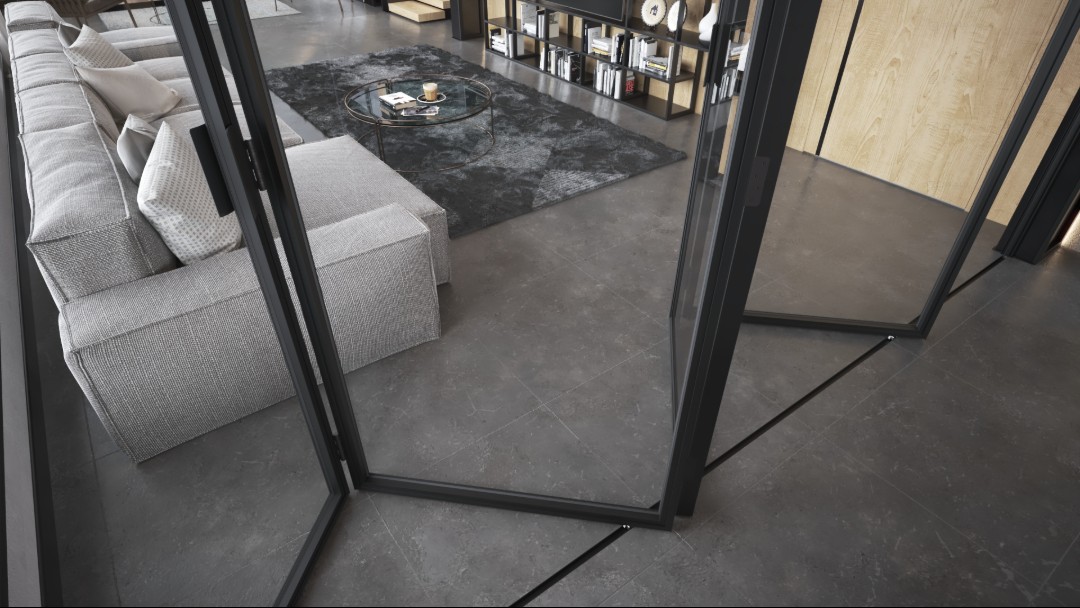
With a glazed folding door, the eye goes first to the divisions. Wide frames make it look heavy; narrow aluminium profiles give the architectural precision many owners and planners look for: calmer lines, larger glass areas, and a door that feels integrated rather than added.
In loft or minimalist interiors this is decisive: a slender folding door should structure the space, not dominate it. Check sightlines and profile geometry early; a few millimetres often make a bigger visual difference than expected.
Aluminium is not just a design choice here. It keeps its shape at narrow sections and stays robust in daily use: the door runs precisely, does not deform like softer materials and keeps its clean lines for years.
Not all glass is the same
Glazing determines safety, acoustics, light and privacy. Clear glass looks open and clean but allows full view. Satin or acid-etched glass is more discreet but slightly reduces the sense of depth. Smoked or tinted glass adds strong character and changes the mood of the light.
In professional interiors, safety requirements matter: toughened or laminated safety glass is a basic requirement, not an extra, for load capacity and breakage safety, especially for large elements or busy areas. Grip zones, impact surfaces and cleaning should be considered too.
Acoustically it is even more complex. Many glazed interior doors look good but insulate poorly. For home offices, meeting rooms, practices, hotel rooms or quiet living zones, look at the whole door system: sound insulation comes from glazing, seals, profile design and precise installation together.
Technology you feel every day
A folding door proves itself in use, not on the data sheet. How easily does it run? How precisely do the leaves close? How stable is the hardware after years? This is where real development separates from short-lived showpieces.
In multi-leaf systems, carriages, guide tracks and pivot points must work in perfect harmony. Opening must be neither heavy nor uncertain, and the open leaves should stack compactly without narrowing the passage unnecessarily. For planners and installers, repeatable accuracy is key: dimensionally stable profiles, compatible hardware and clear connection details save time on site.
Sound insulation with glazed folding doors
A common myth says a lot of glass automatically means poor sound insulation. In reality it depends on how consistently the system is designed: glass thickness, perimeter seals, stable frames, precise closing points and connections to floor and ceiling.
In noisy city apartments, modern offices or mixed-use buildings this matters most: the glazed division should create openness but not pass on every sound. A premium aluminium system handles this better than simple standard constructions. XS-ALU's glazed bi-fold door is developed with sound insulation in mind, so slim sightlines and acoustic performance go together.
Planning starts with the opening, not the door
The key question is not which door is beautiful, but how the opening will be used. Should a living room open completely? Is a flexible link between kitchen and dining needed? Or a temporary division for an office while daylight still flows through? The number of leaves, opening direction, stacking position and division grid follow from these answers.
Clarify wall and ceiling structures early: a folding door needs different fixing and load transfer than a standard door, and shell, interior and floor build-up are directly connected. Late decisions often cost aesthetic quality or force structural compromises.
Also check the real clear width when open. On plan, folding systems often look more generous than they are: stacked leaves need space, and depending on leaf width and stacking this noticeably reduces the usable opening.
Which projects is it ideal for?
In premium homes, a glazed folding door is ideal when open plans should not always be fully open: living room and study, kitchen and dining, bedroom and wardrobe can be separated without losing daylight.
In commercial projects the benefits are even clearer. Law firms, creative agencies, practices or hospitality often need transparency, zoning and a representative look at once, and a well-designed folding door delivers this more elegantly than mobile partitions and far more openly than solid doors.
For fabricators, dealers and installers, the depth of the system matters: modular planning, safe installation and repeatable quality instead of improvisation.
What separates premium from standard
The difference is rarely visible at first glance and almost always felt after installation. Standard systems often use wider profiles, simpler hardware and limited acoustic or size options. Premium solutions offer slimmer sightlines, better glass integration, more durable running gear and more freedom in sizes, divisions and finishes, plus the things often underestimated in sales: quality feel, clean joints, a calm closing movement and an overall impression that still feels premium years later.
What really counts in the decision
Think in performance requirements, not product categories. How much transparency is needed? What acoustic separation is expected? How slender should it look? How intensively will it be used? How precisely must it fit an existing or new interior? The more precisely these are answered, the easier the right solution is defined, and the door becomes not a compromise between technology and design but an element that visibly unites both.