14 November 2026
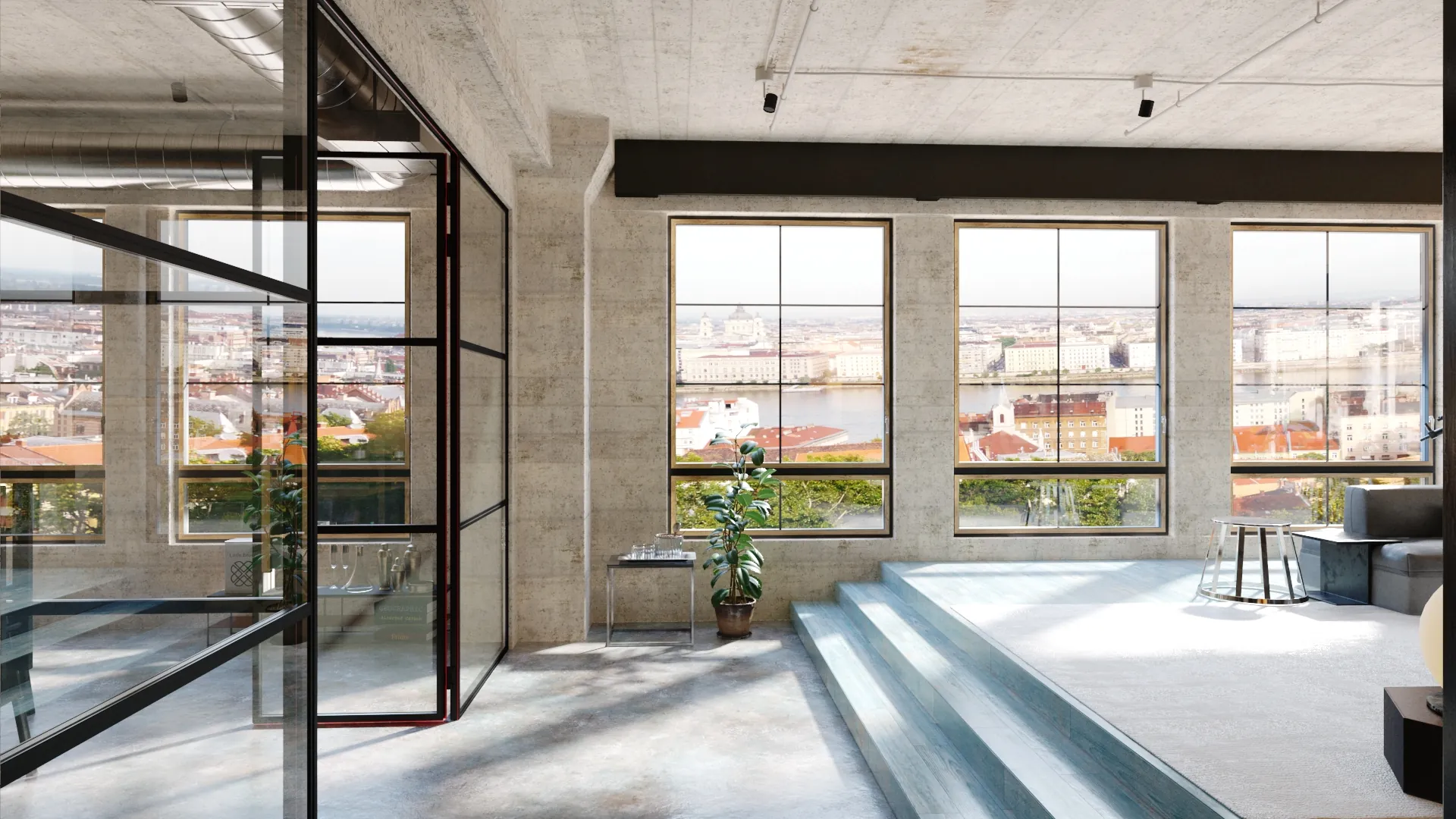
The black-framed loft door with divided glass started out in the steel windows of old factories and workshops. Today it is one of the most popular interior doors in homes, offices and hotels. Many people picture it in steel – yet for most homes and offices, aluminium is the better choice. Here is why.
1. No rust – not even in bathrooms or wine cellars
A steel loft door has to be protected by paint. But a welded structure cannot be coated perfectly everywhere, and the frame has to be drilled through in several places during installation. At these points – and wherever the paint gets damaged – the frame starts to rust in humid rooms or houses by the sea. Stainless steel solves this but is considerably more expensive. Galvanised steel profile systems take many working hours to fabricate and cost far more to produce than aluminium. Aluminium does not rust by nature, so it can be installed in bathrooms, wine cellars and humid rooms without worry.
2. Stays straight – and insulates better
Steel loft door profiles are welded. Welding heat distorts the steel, so steel loft doors are rarely perfectly straight – and sound gets through even the smallest gap. Our aluminium profiles stay straight and dimensionally accurate, so the seals close evenly along the whole frame.
3. Lab-tested sound insulation
A typical steel loft door offers 15–25 dB and a conventional interior door 20–30 dB of sound insulation. Our values, measured in an accredited laboratory:
| System | Sound insulation (Rw) |
|---|---|
| Modulusz 50 doors (hinged and sliding), depending on glass | 30–40 dB |
| Modulusz 50 fixed glazing, depending on glass | 31–41 dB |
| Twin 61 double glass wall | 38–45 dB |
Our doors reach 40 dB with a profile depth of only 50 mm and double glazing (ÉMI laboratory test, 2022). The tests were carried out on larger-than-average doors, because the larger a door, the harder it is to soundproof.
4. Lighter – even in large sizes
Aluminium is much lighter than steel. Even large, XXL leaves open easily, and hinges, walls and floors carry less load. A Modulusz 50 hinged leaf can weigh up to 150 kg.
5. The same look – in any colour
Black anodised as standard, and paintable in any RAL colour, powder-coated by a Qualicoat-certified coater. Glass can be clear, fluted, satin or bronze. We design horizontal and vertical divisions to suit the space, and make bent profiles for arched openings (fixed glazing from R350 mm, doors from R450 mm).
An important difference: aluminium can be anodised, steel cannot. Anodising is not a coat of paint but a hard oxide layer grown from the aluminium surface itself, so it cannot chip or peel like paint. Black anodised aluminium has a refined look similar to a black PVD coating: the texture of the metal stays visible and can be felt. A steel frame has to be painted or powder-coated, and that layer hides the character of the metal.
What you get from XS-ALU
- Our own loft door system with CE marking (Modulusz 50 hinged and sliding door, fixed glazing, Twin frame).
- Premium hardware even in the basic model: FSB handles, WSS, BEVER and Häfele locks, design hinges developed with Dr. Hahn.
- Over 120 projects and around 200 made-to-measure loft doors and glass partitions every year.
- Production time: 6–10 weeks from the signed drawing and advance payment.
Details and technical data: Interior doors & glass partitions.
Frequently asked questions
How much does an aluminium loft door cost? Every door is made to measure, so the price depends on size, opening type, glass, colour and hardware. We prepare an exact quote free of charge from your dimensions, a sketch or a photo.
Can aluminium loft door profiles be welded? Yes, our profiles are weldable and can also be joined with click corner connectors.
Are sliding, pivot or bi-fold versions available? Yes, the Modulusz 50 system includes hinged, sliding, pivot and bi-fold doors as well as fixed glazing, all with the same slim profile.
Where can I see the doors? In our showroom in Neusiedl am See (Austria) or at our headquarters, by appointment.